Harvard economist warns of painful bubble burst, urges fiscal restraint amid growing volatility
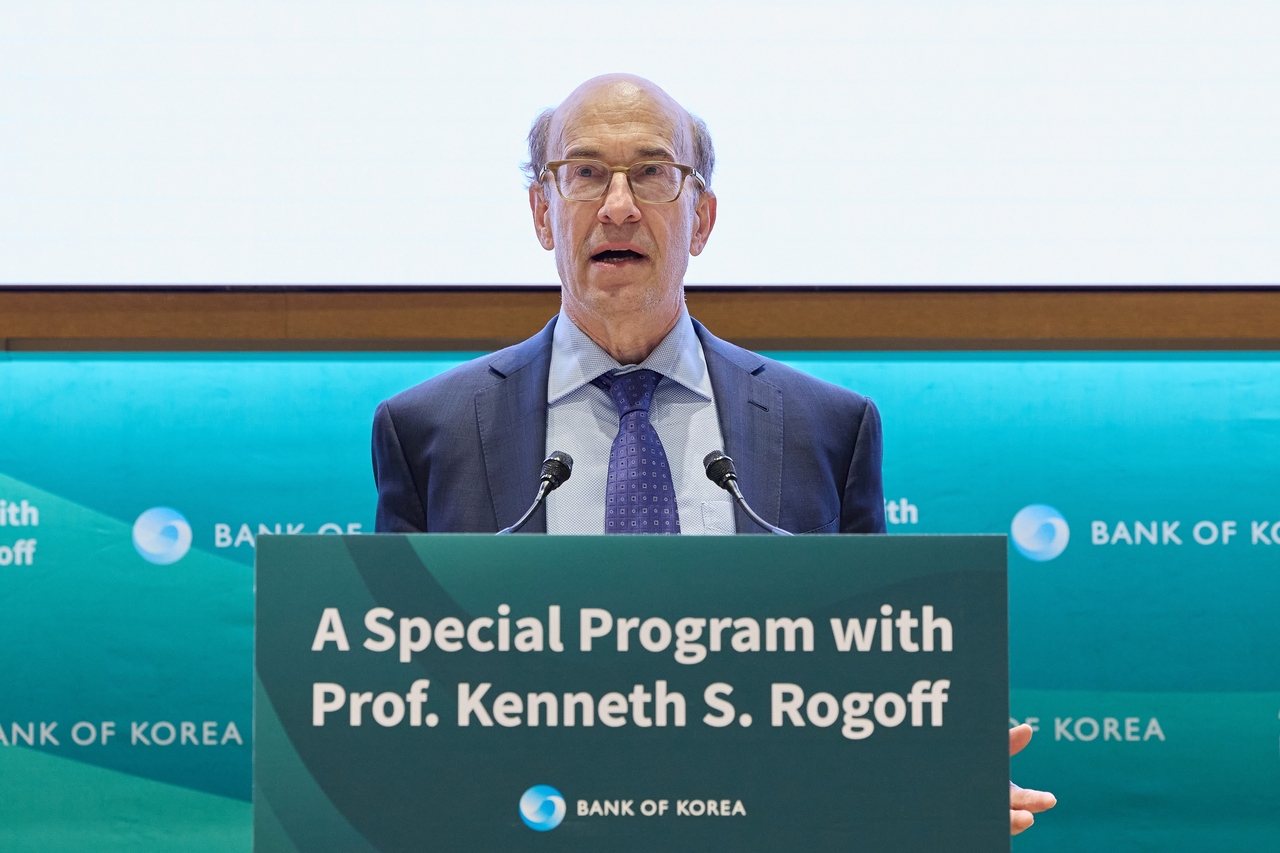
Economist Kenneth Rogoff warned Thursday that an AI bubble burst could hit South Korea particularly hard, urging policymakers to prepare for greater economic volatility and mounting fiscal pressures.
"There is clearly going to be a bursting of the AI bubble at some point that is going to be very painful. Now, that will be very painful in Korea," said Rogoff, a Harvard University economics professor and former chief economist at the International Monetary Fund.
He made the remarks during a panel discussion following his lecture on secular stagnation at the Bank of Korea in central Seoul.
Rogoff cautioned the Korean government against expanding spending commitments too aggressively during economic upswings, warning that the AI-driven boom could expose the economy to greater volatility.
"You are starting from a very favorable position, but then that is going to make the demands very big," he said.
He also warned that rapidly expanding AI could put upward pressure on living costs and resource prices, including land and minerals, as demand for AI infrastructure grows.
"I guarantee you that is not going to be a budget that is just going to go up in general, (including) land prices, but also obviously in minerals. There are many resources which AI will devour," he said.
Despite the risks, Rogoff acknowledged that Korea has majorly benefitted from the AI boom, putting it in a more favorable position than economies that missed out on the technological expansion.
"Overall, you (Korea) are huge beneficiaries of almost like a suburb of Silicon Valley. It is much better to be in that situation," he said.
Rogoff also highlighted growing generational tensions as a major challenge for Korea, noting that older generations hold a disproportionate share of wealth and housing assets. Meanwhile, younger workers face greater exposure to AI-driven labor market disruption.
"This is going to involve reshaping how money is spent and how things are done across many societies. That is going to be the biggest pressure on budgets, on fiscal policy: How do you cut a deal between the elderly who worked very hard and created a great country, and yet the young people do need to have hope?" he said.
Turning to monetary policy, Rogoff welcomed the BOK's efforts to internationalize the Korean won, saying wider use of the currency in cross-border transactions could reduce costs and strengthen the economy's resilience.
"Obviously the won is not going to be a global currency, but you can still get a lot of benefits by internationalizing the won," he said.
"I gather the Bank of Korea is moving to do that. I think that is very smart, saving a lot of costs, protecting yourselves to some extent. Modern technology makes this possible in a way that it was not much cheaper."
silverstar@heraldcorp.com